
While commercial vehicles are expected to benefit from strong replacement demand, the two-wheeler and tractor segments are expected to gain from a recovery in the rural economy.
'We should have calmed down the child. We will do an internal analysis on that.'
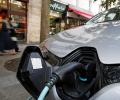
Automobile manufacturers, new and old, as well as ancillary suppliers are set to spend a combined Rs 70,630 crore over the next five years on either entering the electric vehicle segment or stepping up their presence in it. Data culled from announcements made by firms shows India, the world's fifth largest automobile market, is poised to receive one of the biggest capex pushes ever to fuel the transition from internal combustion engines to electric motors and batteries as part of a green drive. The EV push, egged on by the government's emphasis on electric mobility to meet its net zero targets, is expected to yield at least 25 electric vehicles - new ones as well as electrified versions of existing vehicles running on internal combustion engines.

An opportunity to enter a burgeoning sector at a low valuation and favourable policies are propelling some of India's largest corporate groups to scoop up drone start-ups. "Indian corporations lost the race in aerospace and space tech. "No one wants to miss the bus this time. "These are seasoned businessmen and they realise that the market cap of tech companies with problem-solving capabilities will exponentially rise in future," says Vipul Singh, CEO of Aarav Unmanned Systems (AUS).

After a two-year lull, the deal pipeline in India's hospitality sector, which has witnessed a strong revival since the second wave of the pandemic receded, is running full. Family offices, high net-worth individuals (HNIs) and institutional investors are looking at the sector with renewed interest, according to investment and transaction advisory firms working on multiple deals. Most of them declined to divulge details of the deals for reasons of confidentiality. The cumulative debt of the tourism, hotels and restaurant sector rose 8.2 per cent year-on-year (YoY) to Rs 64,408 crore as of March 25, 2022 against Rs 59,519 crore on March 26, 2021, according to the Reserve Bank of India.
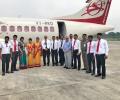
Tata-owned Air India has launched a Voluntary Retirement Scheme (VRS) for its employees- in the airline's first drive to reduce headcount. The salt-to-steel conglomerate acquired the carrier last year. As of November 2019, the airline had 9,426 permanent employees.
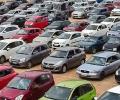
The economy segment of India's car market is unlikely to revive soon term as inflation and prices prompt buyers to defer purchases. The share of entry-level cars in the passenger vehicle market dropped to the lowest in seven years at the end of the Financial Year 2021-22 (FY22). A recovery in the segment will be largely driven by the overall economic growth, improvement in income levels, and easing of semiconductor shortage, say carmakers and analysts.

Hundreds of pilots are staring at a long wait to get the job of their dreams after completing the course, the cost of which runs to Rs 1 crore.

American automaker Ford on Thursday said that it had withdrawn plans to manufacture electric vehicles (EVs) in India and it won't invest in the country under the performance-linked incentive (PLI) scheme. "After careful review, we have decided to no longer pursue EV manufacturing for exports from any of the Indian plants. "We remain grateful to the government for approving our proposal under the PLI and for being supportive while we continued our exploration. "Ford India's previously announced business restructuring continues as planned, including exploring other alternatives for our manufacturing facilities.

Maruti's strategy for the SUV segment is to arrest the decline in customers for entry level hatchbacks.
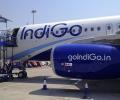
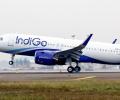
Disability rights came under the spotlight again as the country's largest airline IndiGo refused to let a teenager with special needs board its aircraft. While the twitterati as well as fellow passengers have called for strict action, IndiGo has stood by its action saying the airport manager took the decision to ensure safety of other passengers. "Throughout the check-in and boarding process, our intent of course was to carry the family. "However, at the boarding area, the teenager was visibly in panic.

Recently, TPEM's first born electric concept, Avinya broke cover. The model promises a minimum range of 500 kilometres and advanced technology features, aimed at buyers in India and outside. TPEM, the newly formed entity may also consider a separate dedicated sales channel for the EVs with a distinctive corporate identity once the volumes reach a critical mass and throughput is large enough for the dealers to be profitable, said Chandra. Elaborating further on the hiring strategy he said, "We will hire from everywhere-wherever the talent of the required competency is available."

The regulator has warned airlines and in an email on May 2 asked all Indian carriers to give compensation and facilities to passengers affected by such denial of boarding, failing which it would will impose financial penalties on them.

Coordination between defence and civilian authorities has freed up airspace for commercial airlines in India, resulting in routes becoming shorter and costs coming down, apart from mitigating pollution. "Due to various restrictions of the military, only about 58 per cent of the Indian airspace was being utilised. It is close to 70 per cent now," said an official of the Airports Authority of India (AAI). Officials of the AAI said to date 119 routes had been shortened. Sources said since December 2020 the cumulative savings of airlines had been close to Rs 200 crore while there was a reduction in emission of around 45,000 tonnes of carbon.
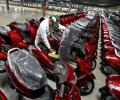
So far at least eight incidents of EV fires have been reported in just over a month's time.
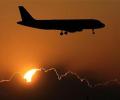
A continuation of the highest standard by the FAA will be a relief for Indian airlines especially the Tata group which intends to increase Air India flights on India-US routes. US aviation watchdog Federal Aviation Administration (FAA) has completed the audit of India's aviation regulator DGCA. Sources said that the FAA team was satisfied with the work and changes in regulations by India and is likely to maintain a Category 1 status rating under its International Aviation Safety Assessment (IASA) programme.

'If the Indian government actually delivers on the infrastructure plans, the hospitality sector would double itself by 2025.'

Ola Electric became the latest among electric scooter (e-scooter) makers to have started the exercise of recalling a specific batch of its model after a rap on the knuckles by the government. Union Minister of Road Transport & Highways Nitin Gadkari on Thursday advised electric vehicle (EV) companies to act responsibly by identifying and recalling defective batches without waiting for orders or guidelines from the ministry. The Bengaluru-based start-up is conducting pre-emptive diagnostics and health check on 1,441 scooters, it said in a statement on Sunday.

If that happens, Jet Airways will be the first bankrupt airline which will be revived under the Insolvency process.

Nepal's decision to ban the import of non-essential items amid depleting forex reserves may hit Indian exports. The country's central bank - Nepal Rastra Bank - last week instructed commercial banks not to open letters of credit (LCs) for importing non-essential items. This is to prevent further decline of the country's foreign exchange reserves. However, it has not issued any formal communication yet.
 © 2026 Rediff.com - Advertise with us - Disclaimer - Privacy Policy - Sitemap - Feedback - About us - Terms of use - Grievances